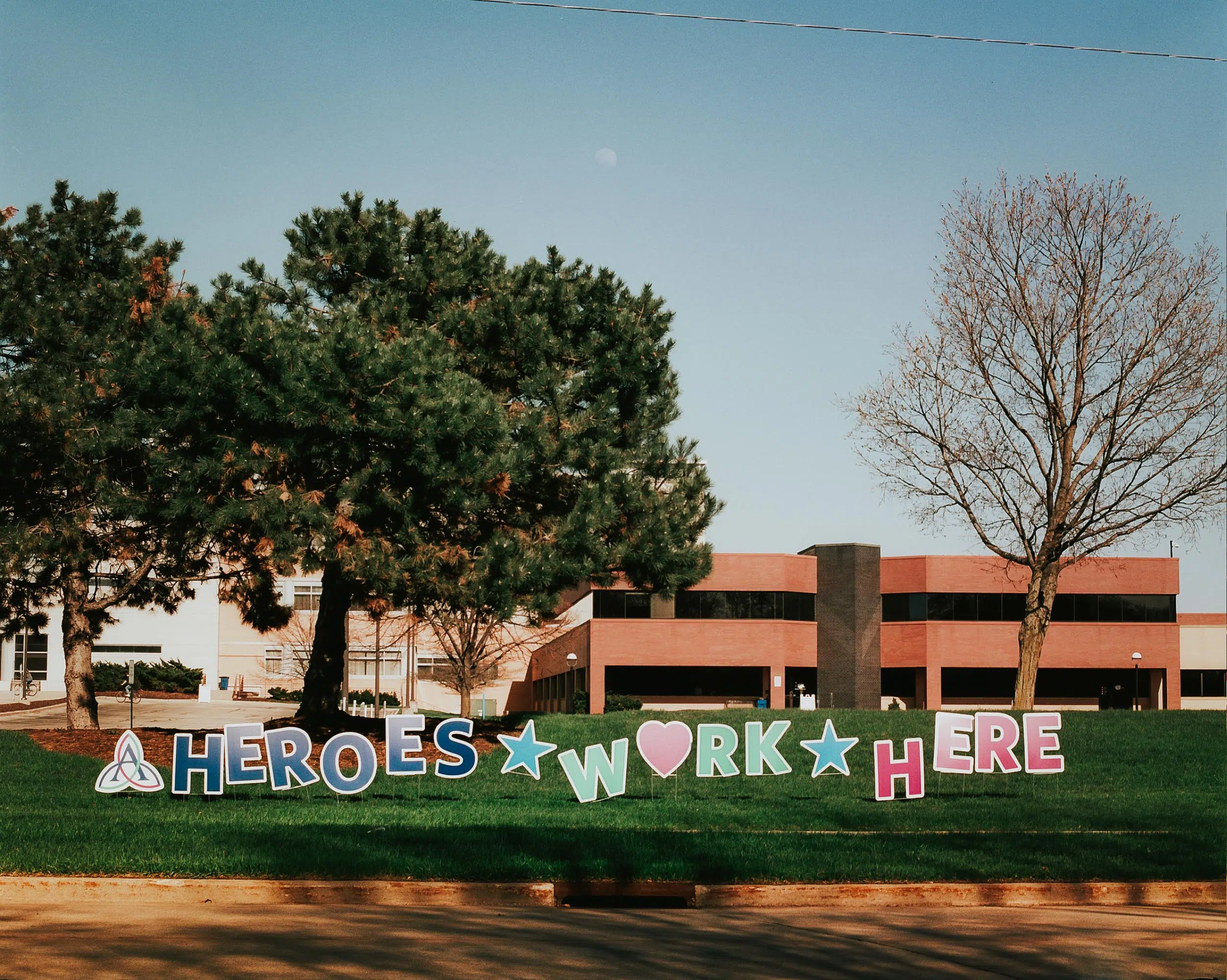
APPLETON, WI (WTAQ) – If you drive past just about any hospital or care facility that employs healthcare workers, you’ll likely see a sign saying something along the lines of “Heroes Work Here.” But right now, the people that phrase refers to – aren’t having it.
“If you ask any healthcare worker right now if they view themselves as a hero, they they kind of bristle at that term,” said Vice President of Medical Affairs at Ascension St. Elizabeth and Surge Section Chief of Ascension Wisconsin, Dr. Tom Nichols.
As the COVID-19 pandemic continues to surge, doctors and nurses have been working hours that make their long shifts from this time last year look like a walk in the park. The impact of the COVID-19 pandemic is clear as they suit up in layers to assist patients with complicated ailments – or diseases we still don’t know much about.
“Their shifts are hard. They’re physically hard and they’re emotionally hard,” Nichols said. “It takes several minutes to put that equipment on. The equipment’s very uncomfortable. And then they have to go and see a patient who may be afraid of dying, and that nurse may be that person’s primary contact point or really become their surrogate family while they’re in the hospital.”
Most of those patients aren’t allowed to see family in-person due to COVID restrictions. Some might get to talk via FaceTime, Skype, or Zoom – but most haven’t seen their families in quite some time.
Those doctors and nurses are working twelve-plus hour shifts with full protective gear. The job isn’t one that just anyone could do, and some people even marvel at the ability to stay the course. But why do these healthcare professionals shake off the term ‘hero’? To many of them, it appears to be lip-service.
“It implies they have super powers, and they really don’t. They’re humans just like the rest of us, and they’re tired…They don’t have a cape that they can take off when they go home. When they go home, they have to attend to their families, and have to buy groceries, and do their bills, and all the other things that all the rest of us do,” Nichols explained. “They would prefer that we stop calling them heroes and start honoring the work that they’re doing by taking action in the community to try to reduce some of the infections that we’re seeing in the community.”
Over at ThedaCare, leaders are echoing that feeling. While healthcare workers, especially those working in COVID units, are putting themselves at risk of contracting a potentially dangerous illness on a daily basis – that somehow appears to be safer than most other activities.
“Throughout ThedaCare, the number of staff that have become infected with COVID, a majority of them have been community-acquired. Less than one percent of our COVID-positive case employees are from work exposure,” said ThedaCare Chief Medical Officer Dr. Mark Cockley.
Cockley says it’s important to work to reduce the spread in the community not only to protect healthcare workers, but to avoid over-taxing them as much as they’ve seen recently with the burden of illness.
According to Nichols, on a typical day, pre-COVID, hospitals across the Fox Valley and the state would generally operate about 80-90% of their staffed bed capacity. Ascension hospitals have seen hundreds of additional patients with COVID. There were about 270 COVID patients in their hospitals statewide this week, which is down from the peak of over 380. However, Nichols says the issue is coming up with the additional staffing and resources to take care of all patients during such a surge.