
GREEN BAY, WI (WTAQ) – Green Bay Police are crediting the use of forensic genealogy for the arrest of a suspect, 34 years after he allegedly killed a woman in the city.
“Solving a case like this isn’t just once in a lifetime for detectives. It’s once in a generation for a whole squad room of detectives,” said Chief Andrew Smith. “Through the years, different generations of detectives in our squad room have held this case, continued to work on it, re-interviewed people and continued trying to locate the individuals and hold them responsible for this.”
“Today is a sad day, but it’s also a very good day. It’s a day because we brought justice to an individual who definitely deserved to be locked up,” said Special Agent Robert Hughes from the FBI unit in Milwaukee.
Investigators spoke about the case during a news conference on Monday. They utilized forensic genealogy to build more than a dozen reverse family trees to identify 65-year-old Lou Archie Griffin as the suspect in the 1986 murder of Lisa Holstead. Holstead’s body was found in a swamp in what is now the Ken Euers Nature Area.
“Solving a case like this is not just as simple as taking a sample, putting it in a database, pushing a button, and waiting for somebody to tell you who it is. It took a lot of good detective work, it took a lot of tenacity to solve this case,” Smith said. “Forensic genetic genealogy is very complicated, it’s something I don’t understand very well.”
Someone who does understand it is Detective Dave Graf. Graf has spent countless late nights at his desk trying to crack the case. He says DNA samples from the scene were essential evidence.
“Over the years it’s been tested by the crime labs in the state of Wisconsin and also checked with the Quotus(?), which is the national database. It never came up as a match to anybody,” Graf said.
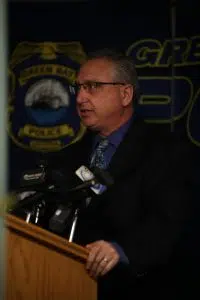
Green Bay Police Department Detective David Graf. (PHOTO/WTAQ News)
The issue – Griffin had been arrested in the past, but never had DNA on file that would have been a hit in any database.
“I sent extract from a DNA sample of a potential suspect to a lab, which then did some analysis on it and came up with more genetic information and just what a crime lab could come up with,” Graf explained. “We were able to identify the person’s heritage, where they’re from, but also using some of the common websites, we have identified some relatives. They’re not real close relatives, but close enough…Basically we were doing a family tree in reverse. With that, we’re able to whittle it down to Mr. Griffin. He fit our profile very well, he was living in Green Bay at the time.”
Detectives tracked the genealogy to a group of people living in Wisconsin and checked any past addresses to see how they’re related, and whether any of them lived in the Green Bay area. Graf says they had to slowly but surely whittle down the list.
“He had just gotten out of prison for sexual assault and then moved up to Green Bay about a month before, so that was another factor that brought our attention to him,” Graf said. “The culmination of where he lived at the time and his past history is what really helped us drill it down to him.”
Once Griffin was identified, the Racine County Sheriff’s Department and state Division of Criminal Investigation located him. Police tracked Griffin and got his DNA from beer cans and a cigarette he threw away.
“There are other individuals, obviously, that we looked at too. But once we were able to get his DNA and compare it, we knew we had the person,” Graf said.
The complaint says Griffin initially denied ever seeing Holstead. However, when presented with the DNA evidence, he said he must have had sex with her but did not kill her. He said he did not remember having sex with her.
There are a number of similar cases in Green Bay, but Chief Smith says no case ever goes cold.
“We do it for the family and we do it for the friends, and we do it for people like Lisa Holstead’s son who’s now about 40 years old. But mostly we do it for people like Lisa Holstead, who’s not there to tell us what happened,” Smith said. “Hopefully it sends a message to everybody that we’re not going to stop we’re not going to give up we will continue to work for justice as long as it takes until those people that have done wrong receive justice.”
A $1 million cash bond was issued for Griffin last week. He is due back in court December 10th.