GREEN BAY, WI (WTAQ) – Five years and $6.2 million later, Green Bay Water Utility crews removed the final lead service pipes in the city along Emilie Street on Tuesday.

Green Bay Water Utility General Manager Nancy Quirk speaks during a press conference addressing the removal of lead pipes in the city. (WTAQ/Casey Nelson)
“I’m so proud . And the commitment to public health in this community is ‘ginormous’,” said Green Bay Water Utility General Manager Nancy Quirk. “Our employees care a lot. We understand that we are deliverers and providers of safe drinking water. When this COVID thing hit, we were deemed critical, essential workers – because where would we be without clean water?”
The health risks associated with lead contamination have been documented now for years. That was a key reason behind the effort to dig up all lead services across the city.
“The science is that that’s how it leaches into the water. Our Lake Michigan water that we treat does not have lead in it. If you look at our raw water data, there’s no lead in there. It only happens when it comes in contact with these plumbing materials,” Quirk told WTAQ News. “It only happens when it’s getting contacted with these lead pipes. So let’s get the source out and work on that first.”
But before replacing over 1,800 utility-owned pipes and coordinating 247 private lead services, the city had to find them. That effort had them tracking down records dating back to the late 1800’s to figure out exactly where those pipes had been buried. Once they were found, they were added to the list to be metered and moved.
Prior to a press event on Tuesday morning, crews dug holes and geared up to make quick work of the lines leading into Deb Weaver’s home.

A sidewalk along Emilie Street in Green Bay is closed as Water Utility crews work to remove a lead pipe. (WTAQ/Casey Nelson)
“I just love the fact that the leadership of our city made this a priority…And it’s neat that they had the press conference here too, because it’s a sense of community. That’s the one thing I love about Green Bay, is it is a community,” Weaver said. “They finished it a couple of months ahead of schedule. It really shows the commitment that they have. So yeah, I’m celebrating that I’m the last home and that it’s done!”
Weaver moved to Green Bay from South Carolina about six years ago. Prior to that, she lived in Michigan.
“Lead leaches into everything, and I just am grateful that Green Bay is at the forefront of making this a priority. We don’t want a situation like what happened in Flint,” Weaver told WTAQ News. “I didn’t realize just how immense the project would be. It really takes a team to identify it, it takes a team to eradicate it, and then to replace it.”
As we spoke with Weaver, a crew of water utility employees walked into her basement with a pump and other equipment to make sure the connection was working properly.
“They’ll put that pump on and they’ll put a hose out and make sure they run that service once it gets re-hooked, so that we get any particulates that made it out during the placement away from home,” Quirk explained. “We understand our responsibility at the water utility. We have people throughout the utility who are on National Committees, state committees, making sure that we’re getting the latest science and the latest technology that’s going on so we can make good choices for our residents.”
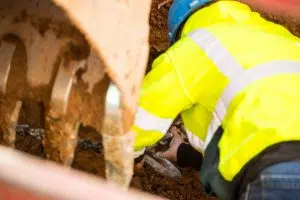
A Green Bay Water Utility employee hooks up a lead pipe to be removed along Emilie Street. (WTAQ/Casey Nelson)
But another major benefit for the residents impacted by the project, is that most of them paid little or no cost to have their lines replaced. Generally, the water utility owns the pipes under the street and up through the terrace and to the sidewalk. But once that crosses under the sidewalk and under a resident’s yard and into their home, that becomes their responsibility.
“[For] our homeowners, we’ve secured funding and grants that they did not have to pay a cent to get their lead replaced,” Quirk said. “Our teams in our engineering section coordinated with the contractors and got the safe drinking water loans right to the contractor, so that the homeowner didn’t have to pay anything.”
The overall process was fairly efficient. That seems to be what caused the project to draw attention from the federal government. Assistant Administrator for the Office of Water at the Environmental Protection Agency (EPA), Dave Ross, hopes to use Green Bay as an example.
“Green Bay is out in front. There are lots of communities that haven’t started taking lead out, so part of our initiative across the federal government is trying to figure out how to replicate what Green Bay has done and do that throughout the rest of the country,” Ross said.
For more information about the Green Bay Water Utility, or if you’re curious about your own water quality in the city, head to their website for more information.